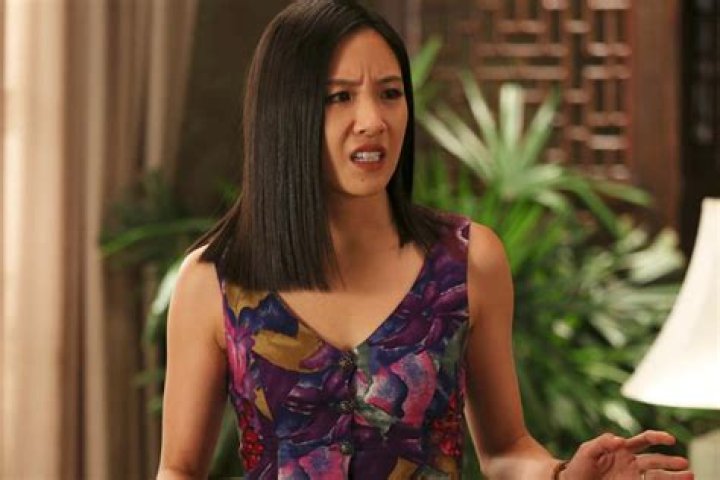
I loved Hustlers, but as I said in my mini-review, I thought Constance Wu was actually the weakest part. She was the “lead,” but for half of the film, she was mostly a stand-in for the audience as she watched and worshipped Jennifer Lopez’s character Ramona. Constance Wu is a talented actress, but I’m not sure Hustlers was her best showcase. But whatever, she wasn’t actively bad in it. Wu has had such a big two years – the success of Crazy Rich Asians, the success of Hustlers, and Fresh Off the Boat getting renewed… which is what Wu threw a tantrum about back in May. She was mad because she has too much work, too many opportunities. Yeah.
Anyway, Wu has a lengthy new profile in the New Yorker and it’s worth a read. I came away from it understanding her a bit more. She really let the New Yorker into her life and work, and she even let the journalist come to her acting coach sessions, where she’s pretty vulnerable, and where she’s basically getting therapy. She talks about her FOTB tantrum and how she’s not looking to have every conversation be about her Asian-American identity. You can read the full piece here. Some highlights:
On stereotyping, or playing stereotypes: “If somebody just so happens to fall into stereotypical traits, it doesn’t mean that we should try to take that part of her away and hide it from the light. Because that’s a manifestation of shame. If anything, I think that people who have been reduced by pop culture their whole lives deserve to have their stories expanded upon.” Later, she added that she always found it weird when Asian actors refused to play stereotypes. Why, she asked, when there weren’t enough Asian roles, would you turn one down, rather than take the opportunity to invest a stock type with “character and human experience that it’s never f–king gotten?”
Growing up in Richmond, VA: “Richmond is the city that built me. There was a lot of J. Crew and Ann Taylor.” Wu is still surprised when people comment on her staunch embrace of an American identity. Once, on “The Ellen Degeneres Show,” when asked where she was from, she reflexively answered, “Richmond.” “There was a whole thing online where Asian-Americans were saying how rad it was that I said it so naturally. But I really wasn’t trying to make a statement.”
She was “pro-life” when she was very young: But she became a woman who campaigned for Hillary Clinton in 2016, is now pro-choice. “I was proud of being a virgin when I got to college. Because, where I come from, it was cool to wait until marriage.”
Being Asian-American doesn’t define her: “Look, when Tom Cruise is in an interview, people aren’t, like, ‘What’s it like to be a white actor?’ My answers coincide with Asian-American activism, but that’s because those are the questions I’m being asked. It doesn’t mean that I don’t believe in it and that I’m not a proponent of it. But is it my reason for being alive? No.”
On the Twitter tantrum: “Being messy in public is something— I’m not proud of what I said. But I also think that it was how I was feeling in the moment, and we all have days where we feel differently, and I don’t think it represents my entire character.” Wu wondered if role models—“and I don’t want to be a f–king role model, I’m an artist… Wouldn’t that make people feel a lot less lonely when they were having the feelings and emotions that weren’t the prescribed ones? I’m glad people are talking sh-t about me, because it makes me think about other people’s feelings and the effects of things. It’s like negotiating authenticity with obligation, and I don’t have an answer either way, because I think you have to actually clarify what your obligations are first and what your authenticity is first.”
I have no idea what she’s talking about with “authenticity” and “obligation.” Is she saying that her Twitter tantrum in May was her authentic self and she’s had to tamp down that “authenticity” out of professional obligation? It’s like when someone does something awful in the name of “keeping it real.” Yeah, you kept it real and now no one wants to work with you.
As for all of the stuff about her Asian-American identity… it’s weird how little credit Mindy Kaling gets for being one of the first big Asian-American women to really “make it” and then talk about the experience of being first-generation American, being Indian-American in America, being Indian-American in Hollywood. I related to what Constance talked about re: growing up in Virginia and all that, just as I relate to what Mindy Kaling says about how much responsibility she feels to speak as an Indian-American woman and not just as “writer/actress Mindy.” There’s no real answer and no real point to this – there are a million ways to BE Asian-American and there are a million ways to talk about the Asian-American experience.
Photos courtesy of WENN and Avalon Red.